Special Report
Oyo, Ogun, Kwara Affirm Decline in Food Prices

 0
0
 0
0

Food and agriculture stakeholders in Ogun, Oyo, and Kwara States have expressed delight at the drop in food prices, praising the Federal Government for its policies and interventions.
In Tuesday’s survey of the News Agency of Nigeria, the respondents, however, cautioned that some loose ends needed to be tidied up to sustain the price reductions across the board.
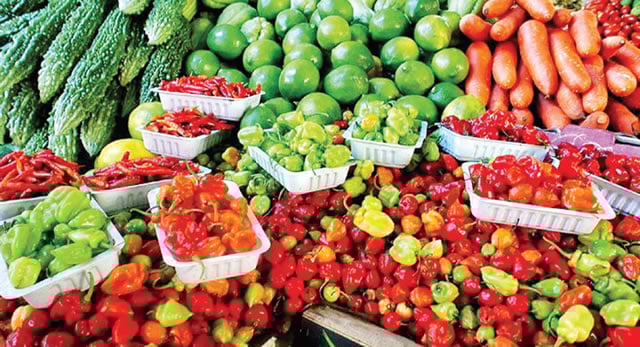
At the Lafenwa, Kuto, and Olomore markets in Abeokuta, the survey revealed a significant drop in the prices of rice, beans, garri, groundnut oil, and yams.
It also showed that the prices of perishable items like peppers, onions, and tomatoes had dropped.
According to the survey, a ‘kongo’ of garri now sells for N500 as against N1,800 in August, while a bag of the commodity now costs N28,000, compared to N40,000 in August.
A 50kg bag of rice now sells for N53,000 from N68,000, while ‘Oloyin’ beans dropped from N70,000 to N60,000.
A 5-litre gallon of groundnut oil, which was sold for N16,000, now costs N13,000, while a 25-litre keg of King’s oil reduced from N70,000 to N66,000.
A medium basket of onions has dropped from N20,000 to N12,000, while a small basket of the same commodity has reduced from N10,000 to N5,000.
Similarly, a big bag of scotch bonnet pepper now goes for between N35,000 and N40,000, dropping from N60,000 and N65,000, respectively.
The small bucket of bonnet pepper, which previously sold for N15,000, now costs N6,000, just as a bag of tomatoes dropped from N70,000 to N50,000.
Meanwhile, six big tubers of yams, earlier sold between N17,000 and N20,000, now sell for N12,000, while medium sizes are sold between N4,000 and N6,000.
Some of the traders attributed the reduction to the recent decline in the exchange rate and reopening of land borders.
This, according to Sikirat Soyeye, a grain seller at Lafenwa market, has eased importation and improved the availability of food items, especially rice and groundnut oil.
“Our businesses have improved; since food items are now cheaper, people are now buying more.
“The reduction in the dollar rate and border reopening have really helped,” she said.
Soyeye, however, appealed to the government to sustain the stability of the naira, adding that traders now record higher sales and patronage.
At the Kuto Market, Tinuke Ayomide, a perishable goods seller, said the reduction in the prices of pepper and onions was due to the current harvest season of the items.
Ayomide, however, urged the government to strengthen security, particularly in the northern parts of the country where most food items originate, to ensure a steady reduction in commodity prices.
Similarly, a tomato seller at Olomore market, Mr Haruna Ibrahim, said the commodity recorded a slight price reduction, but compared with other items, it was still expensive.
Ibrahim also attributed the drop in perishable food prices to seasonal harvests.
A buyer, Ayomide Adedeji, expressed delight at the development, urging the government to sustain the trend through consistent policies.
“Food prices should not rise again, and the government must keep fuel prices stable.
When the dollar comes down, things become cheaper, so the government must ensure exchange rate stability and continue to support local farmers,” she said.
The Ogun Secretary, All Farmers Association of Nigeria, Abiodun Ogunjimi, said the current price reduction reflected a mix of seasonal harvests, reduced transport costs, and improved supply from farms and borders.
Ogunjimi, however, warned that without deliberate government policies, the gains might be temporary.
“To sustain this positive trend, the government should invest in local food production, reduce import duties on essential goods, and provide incentives for farmers.
“Our government should also look into improved storage facilities, rural infrastructure, and price monitoring systems to prevent future inflation and ensure food affordability for Nigerians,” Ogunjimi said.
Meanwhile, the Ogun Commissioner for Agriculture and Food Security, Bolu Owotomo, said the reduction in food prices was due to effective government policies, even as the harvest season is ongoing.
According to Owotomo, the state government has intensified efforts to enhance food productivity and minimise post-harvest losses through various targeted initiatives and interventions.
He added that the state had done exceptionally well in the cassava industry and aquaculture sector, with thousands of farmers benefiting from capacity-building programmes.
The commissioner noted that the government had steadily expanded its input distribution to boost food productivity and was also still building processing facilities across the state.
“We’re not only stopping at providing processing centres, we are also linking our farmers to off-takers so that they won’t have to be the ones to be looking for markets themselves; we already have off-takers registered.
“It’s our joy that the government’s policies and interventions are having a positive impact on food prices in the state.
“Adequate state government interventions have really helped in the reduction of food prices,” said Owotomo.
In Ibadan, Alarudeen Aminu, a Reader in the Department of Economics, University of Ibadan, says the price reduction is largely driven by the nationwide harvest season.
He said food prices traditionally fall to their lowest during harvest periods across Nigeria’s agro-ecological zones.
“This year’s trend aligns with historical patterns, except in periods of drought, flood or other disruptions affecting food production,” he said.
He explained that increased local supply has forced imported food items to a downward readjustment.
“If there is excess supply, the price will fall to clear the market. That is what we are observing now,” he said.
The economist, however, stressed the need for coordinated government intervention to sustain the price reduction beyond the harvest period.
He said federal, state and local governments must invest more in domestic food production to stabilise prices.
According to him, expanding dry-season farming is critical as many farmers have already cultivated vegetables, tomatoes and early yam seedlings using FADAMA.
He urged governments to provide quality seedlings and launch radio and community campaigns to boost participation in off-season farming.
He also urged the governments to identify and support genuine farmers, particularly small-scale holders who supply the bulk of food consumed locally.
Aminu called for stronger rural security to encourage farmers who have abandoned farmlands due to attacks.
He emphasised that rural infrastructure, such as roads, bridges and basic amenities, must be prioritised, noting that such investment is largely the responsibility of the state and local governments.
He, therefore, recommended the revival of a structure similar to the defunct Directorate of Food, Roads and Rural Infrastructure and the Universal Basic Education model.
According to the economist, the structure is to be jointly funded by the federal and state governments.
However, a consumer, Taiwo Ajebamidele, urged the FG to provide more storage and preservation facilities to help control post-harvest surplus and wastage.
“The government can also buy off the surplus harvest from farmers to save their loss now, and resell it off-season.
Although foodstuffs, especially grains and cassava, are now surplus, the off-season time will come.
“However, with good storage and preservation, the preserved ones will be available for sale at cheap prices since they are from the government,” he said.
He also called on the government to reduce the pump price of petrol, which, in turn, would drop transportation costs.
The economy, he says, revolves around petrol.
A housewife, Mary Oguntade, said that while foodstuffs had become cheaper, people’s purchasing power was still weak.
According to Oguntade, though garri, beans, tomatoes and pepper are now selling at lower prices, they may still increase off-season.
She, however, said that the prices of fish, meat, eggs, chicken, palm oil and vegetable oil were still high.
Aduke Adebimpe, a rice merchant at Bodija market, affirmed that the price of rice had crashed.
According to her, a bag of 50kg, which sold between N60,000 and N64,000 in October, now sells between N54,000 and N56,000 across various markets in Ibadan.
“The Indian rice flooded the Nigerian markets from the Benin Republic, pushing prices of both imported and local rice down sharply.
“Another factor in price reduction is the strengthening of the Naira against the Dollar and CFA, thus making dollar‑priced imports cheaper,” she said.
She advised that the duty waiver on the importation of rice be sustained to make rice sell as low as N10,000.
A garri seller, Caroline Joseph, said the price of the commodity has dropped drastically as a bag of cassava, which sold between N10,000 and N15,000, now sells at N9,000.
Joseph said that a big bowl of garri, sold for N8,000, now sells at N4,000.
She, however, cautioned that the price reduction was seasonal, explaining that with the incoming dry season, the price of garri and cassava flour would increase again.
A consumer, Kabir Alebiosu, said that while the prices of rice, beans, and garri had reduced, there was no money to buy other necessary things to cook the foodstuffs.
Alebiosu said that the people’s purchasing power was still low; therefore, urging the government to do more to improve economic policies.
This, he said, would help the civil servants to, at least, feed their families.
In Ilorin, the Iyaloja-General of Kwara, Muhibat Olumon, while commending the government, pledged continuous support to the FG for stabilising the prices of food commodities.
She explained that, as the leader of marketers in Kwara, her team hold regular meetings with middlemen across the state to prevent the inflation of food commodities.
According to her, the market must be sanitised of traders who take advantage of people by inflating prices and coming around to blame the government.
She pledged, on behalf of other traders, to be faithful in their businesses and to remain their brothers’ keeper.
The Public Relations Officer, Tomatoes Dealers Association in Kwara, Nurudeen Alowonle, told NAN that a bag of tomatoes sells between N9,000 and N10,000.
According to him, a 25kg bag of bell pepper (atarodo) now sells between N7,000 and N10,000 in Ilorin.
The survey revealed that a bag of rice has dropped from N70,000 in October to N54,000.
A bag of Elubo (New), which sold for N140,000 in the last two months, now sells for N120,000, while the (Old) Elubo sells for N160,000.
News Agency of Nigeria



Special Report
50 years After, Shocking Revelation: How Muritala Muhammed, Obasanjo Destroyed Nigeria’s Democracy
 0
0
0
0

February 13th 2026 made it Fifty years after late General Murtala Muhammed was assassinated, yet, General Murtala Muhammed has continued to be portrayed as a saviour of Nigeria. However, behind what many describe as his heroic posture lay what an elder statesman Sen. Femi Okunroumu once referred to as a pretentious façade, masking a man he described as a Northern hegermonist.
In a bid to better understand the much-praised General Murtala Muhammed and his administration, Yusuf Adeleke of FortressNews sought deeper insights into his legacy. What emerged is a shocking revelation.
Question: Who was Murtala Muhammed, and why does his legacy still matter fifty years later?
I hope I will not disappoint you, because right from your introduction, you confirmed what I have always believed: that Murtala Muhammed was a highly overrated Head of State. His image has been exaggerated far beyond his actual achievements and legacy.
You talk about fighting corruption. Certainly, if one examines his record during the civil war, it does not portray him as a man opposed to corruption—particularly during the capture of Benin. In fact, his wartime record is replete with allegations of corrupt practices.
What about civil service reform?
It must be stated on record that the destruction of Nigeria’s civil service began under his tenure through what can only be described as misguided reforms based on his personal notions. Before then, Nigeria had one of the best and most efficient civil services in Africa. Under Murtala, however, the service began to degenerate, especially as mass dismissals were carried out indiscriminately—people were fired left, right, and centre.
As a result, morale within the civil service collapsed. Officers lost hope in any meaningful future, which in turn encouraged corruption. People began to take whatever they could, believing there was no future worth waiting for.
Above all, the most troubling attribute of Muritala Muhammed was his Northern hegermanist ideology. People understand what is meant by Northern Germanism. He laid the foundation for the permanent domination of Nigeria by the North—an issue the country has struggled with ever since.
Recall that it was under his administration that Nigeria moved from twelve (12) states to nineteen (19) states. Prior to this, there was relative equity—six (6) states in the North and six (6) in the South. Under Murtala, that balance was deliberately altered in favour of the North.
So, what is your narrative about the man we are discussing General Murtala Muhammed?
That is exactly what I am saying. He was a Northern hegermonist who laid the groundwork for Northern political domination, fostering the belief that it is the North’s divine right to rule Nigeria indefinitely. This mindset has continued to shape Nigeria’s political struggles.
I have already given examples to support this claim. First, he altered the state structure from a balanced six-six arrangement to ten (10) states in the North and nine (9) in the South. Secondly, during his era, alongside Obasanjo the federal government began creating local governments in a manner that further tilted the balance of power in favour of the North. Considering the later political use of local governments, this shift was deliberate.
Furthermore, it was under Murtala Muhammed that the Committee of Forty-Nine Wise Men was inaugurated to draft a new constitution for Nigeria in 1975, chaired by Chief Rotimi Williams. However, perceptive observers knew that the committee was not given a free hand. The outcome was largely dictated.
In his inaugural speech at the Nigerian Institute of International Affairs in Lagos, Murtala explicitly stated that the Supreme Military Council had already decided that a presidential system was best for Nigeria and charged the committee merely to consider it. Once such a decision had been made, what freedom did the committee truly have?
Okunroumu argued that the presidential system remains one of Nigeria’s greatest problems. It effectively produces dictator-presidents who control everything. Once elected, a president can dominate the legislature, judiciary, civil service—indeed, every arm of government. In a corrupt environment like Nigeria, checks and balances become meaningless because loyalty can easily be bought.
With enough money, legislators can be compromised, judges influenced, and public institutions weakened, allowing unrestricted access to the treasury. While we complain about these issues today, they all trace their roots back to Murtala’s era.
Even though the 1999 Constitution attracts the most criticism, its most objectionable provisions were inherited from the 1979 Constitution. Thus, the current struggle for restructuring is essentially a struggle to dismantle the structures planted by Murtala Muhammed.
Even Obasanjo, who served as his deputy, was largely a figurehead, compelled to comply with Northern hegemonic interests under threats to his life. This explains why he could not deviate from the foundations laid by Murtala after his assassination.
When Obasanjo eventually handed over power in 1979, he reportedly returned to Abeokuta to celebrate his survival. This fear also explains why he insisted that a Northerner must succeed him, famously stating that the best candidate would not win a reference to the contest between Awolowo and Shagari.
These Northern hegemonic principles, laid down by Murtala Muhammed, have persisted ever since. In my personal opinion, Murtala Muhammed was grossly overrated and played a significant role in laying the foundation for the destruction of democracy in Nigeria.
Part two is loading…
 0
0
0
0

In a time when public service is often measured by visibility, Prince Abimbola Onabanjo represents a different model of leadership; one defined not by noise, but by results. Across Ijebu-Ode, his name is increasingly associated with tangible progress, steady compassion, and a form of service that places community needs above personal acclaim.
For years, Prince Onabanjo has worked largely outside the spotlight, supporting families, rehabilitating infrastructure, and strengthening educational institutions.
His impact is not announced with fanfare; it is felt in improved roads, better-equipped schools, and households that receive timely support when it matters most. Residents describe his approach as deliberate and sincere focused on outcomes rather than recognition. What distinguishes Prince Onabanjo’s humanitarian work is its inclusiveness.
His interventions cut across ethnic, cultural, and religious boundaries, reflecting a deep belief in shared humanity. From Yoruba to Hausa, Igbo, and others, beneficiaries speak of a man whose generosity is guided by need, not identity. In a diverse community, his actions quietly reinforce unity and mutual respect.
At the grassroots level, his support is both consistent and practical. Monthly food relief, cash assistance, and the distribution of school supplies reach families who are often overlooked. Rather than symbolic gestures, these efforts are designed to preserve dignity and create sustainable relief, ensuring help reaches those who need it most.
Education stands at the centre of Prince Onabanjo’s vision for long-term development. In a landmark initiative, he committed N25 million to support 25 schools across Ijebu-Ode, allocating N1million to each institution.
The program spanned both primary and secondary education, with 15 primary schools and 10 secondary schools benefiting—an intentional strategy to support students at critical stages of learning.
Beyond financial contributions, the initiative delivered direct support to students. Each beneficiary school received 150 school bags fully equipped with essential writing materials, removing basic barriers to learning and reinforcing his hands-on approach to educational development.
Infrastructure improvement is another area where his impact is clearly visible. Prince Onabanjo personally funded and oversaw the rehabilitation of several key roads, including Borogun Court, Ojushagbola Avenue, Abusalawu Street, and sections of Taiwo Osipitan Road.
These projects have improved mobility, accessibility, and daily living conditions for residents, reinforcing the link between infrastructure and quality of life.
Taken together, these efforts paint the picture of a leader deeply rooted in service one who understands that lasting change is built through consistency, empathy, and action. In Ijebu-Ode, Prince Abimbola Onabanjo’s legacy is not written in speeches, but in the everyday lives quietly improved by his commitment to community and progress.
Special Report
Ogijo Lead Poison: Researchers offer solutions to Industrial Pollution Threatens Lives and Communities
 0
0
0
0

Barely two weeks after the Ogun government offered free lead tests for Ogijo residents over alleged lead poisoning caused by seven used lead-acid battery (ULAB) recycling industries, a team of Nigerian researchers, Olaniyi Popoola, Olusola Ogundele, Abayomi Ladapo, and Samson Senbor, made groundbreaking findings that have given a leadway on how heavy metal contamination disrupts soil microbial communities, offering urgent insight into the environmental and public-health dangers unfolding in Ogijo, Ogun State, where lead poisoning from industrial battery operations has triggered widespread concern.
Their research, published in the book, “Soil Microbiome in Green Technology for Sustainability”, provides one of the clearest scientific explanations yet for how heavy metals such as lead, cadmium, mercury, chromium, zinc, and nickel affect both soil quality and human well-being.
From Soil to People: The Hidden Path of Contamination
Heavy metals are persistent pollutants, primarily originating from industrial waste and poorly regulated recycling operations. In Ogijo, battery-smelting sites have released hazardous lead particles into the soil and the surrounding environment. While visible contamination has sparked local alarm, the researchers caution that the real danger runs much deeper.
According to them, the first victims of heavy metal pollution are the microbial communities that form the foundation of healthy soil.
These microorganisms drive nutrient cycling, break down organic matter, support crop growth, and maintain soil structure. When heavy metals accumulate, they interfere with microbial biological processes, reducing biomass, crippling enzyme activity, and destabilising metabolic functions.

“These disruptions are not isolated environmental events—they cascade into the human population,” the authors explain.
As soil loses its microbial integrity, crops absorb contaminants more easily, dust becomes more toxic, and exposure among residents—especially children and pregnant women—rises sharply.
Lead, in particular, is linked to neurological impairment, developmental delays, 88hypertension, kidney dysfunction, and long-term cognitive damage.
Human Health at the Forefront:
While much of this research initially examined microbial changes, the team emphasises that the most pressing concern is human health. Lead and other heavy metals persist in the environment, contaminating soil, water, and food. The contamination is insidious: metals accumulate gradually, entering the food chain through crops and livestock or via dust inhalation, making exposure difficult to detect until severe health effects appear. Chronic lead exposure can have lifelong consequences, affecting intelligence, behaviour, and cardiovascular health.
“Our work goes beyond the soil itself,” says Abayomi Ladapo. “It is a wake-up call for public health authorities. Protecting communities in Ogijo requires urgent interventions that address both environmental contamination and direct human exposure.”
Scientific Solutions and Policy Guidance
The research highlights advanced technologies and multidisciplinary approaches that allow scientists to detect, map, and monitor heavy metal contamination in real time. By tracking contamination and identifying early biological indicators, policymakers and health agencies can design targeted strategies to prevent further poisoning, improve food and water safety, and protect vulnerable populations.
Although soil microbial disruption was a primary focus, the study underscores a critical connection: the deterioration of soil ecosystems amplifies human exposure. Healthy microbial communities act as natural buffers, breaking down contaminants and preventing metals like lead from accumulating in the environment. Their loss increases human risk, linking environmental degradation directly to public health.
A Roadmap Forward
The work of Popoola, Ogundele, Ladapo, and Senbore provides critical guidance for both environmental management and public health interventions. By bridging scientific research and actionable solutions, the team illuminates a pathway to:
• Reduce heavy metal exposure in affected communities
• Protect vulnerable populations, particularly children and pregnant women
• Restore environmental health in Ogijo and similar industrial regions
• Inform policy and regulatory frameworks to prevent future contamination
As Ogijo continues to grapple with the aftermath of industrial pollution, this research stands out as a vital contribution, offering evidence-based solutions to a problem that is as much about human lives as it is about the environment.
-

 Breaking News4 weeks ago
Breaking: Governor Abiodun Declares February 3 Public Holiday for Golden Jubilee Celebrations
-
 News1 year ago
IPAC Meets Gov. Abiodun Over OGISIEC Administrative Fees
-
 Metro4 months ago
Ogun Targets Stronger Women Empowerment Framework, Inaugurates Technical Committees
-

 Metro2 months ago
A New Generation Of Leadership For Ijebuland
-

 Crime4 weeks ago
Communal Clash: Ebonyi Gov Sacks Government Appointees, Withdraws Monarch Certificates, Others
-

 Metro1 month ago
Balogun Shows Solidarity with Panseke Market Amidst Fire Crisis
-

 News2 months ago
Full List of Princes, Princess nominated for Awujale of Ijebuland’s stool
-

 Politics2 months ago
GNI Meets IPAC, Reaffirms Commitment to Inclusive Democracy in Ogun